Geography Games for Preschoolers: Flags, Maps and a Big Wide World
By Cubic Frog® Studio ·
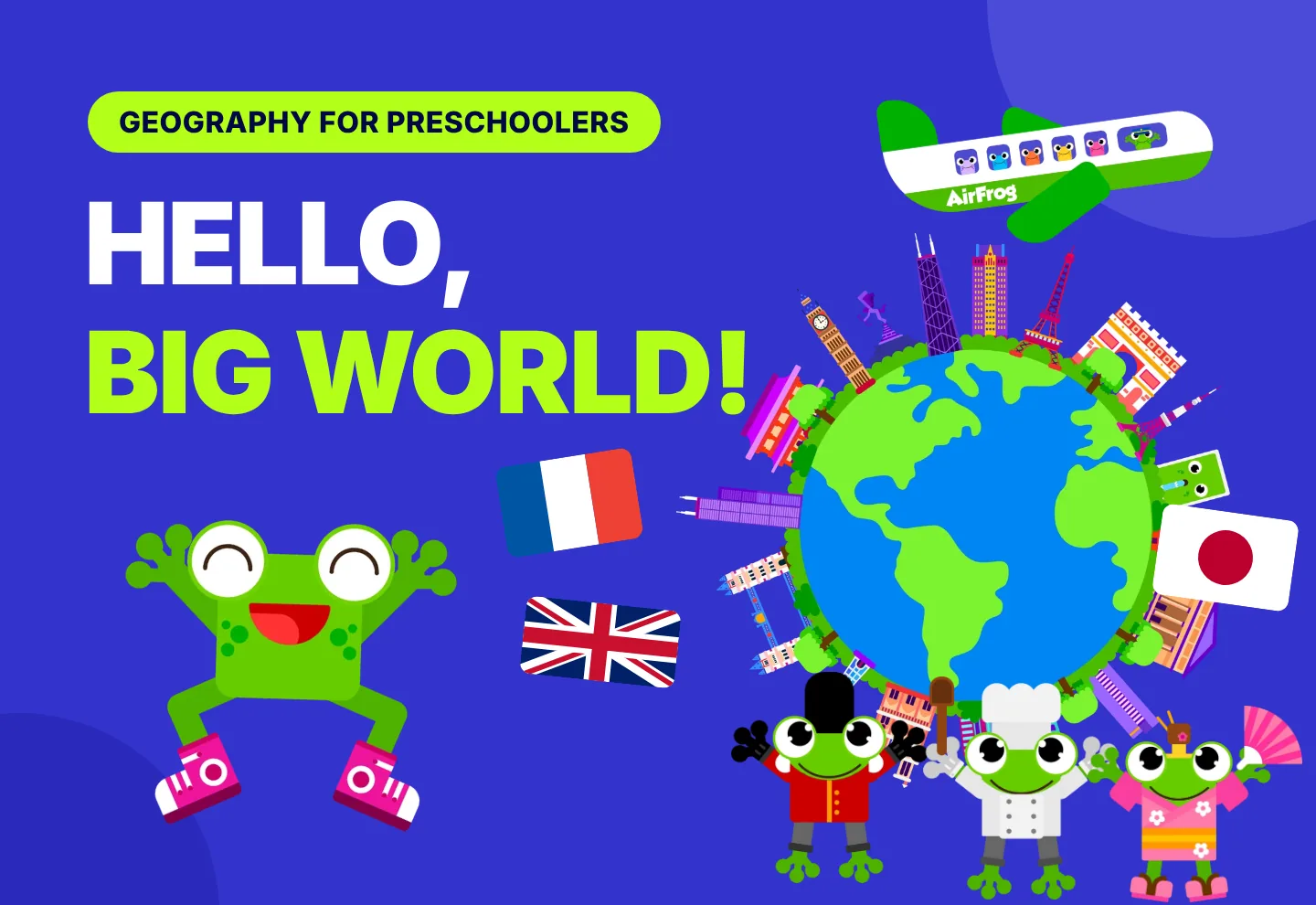
A preschooler doesn't need to find Peru on a map. But they can already learn that the world is big, that places look different, and that people everywhere eat, play, travel and say hello in their own way. That is where geography starts.
Quick answer: The best geography games for preschoolers are short, playful activities built on things children already love: colors, shapes, pretend travel and food. Flag games, simple room maps, pretend suitcases and saying hello in new languages all work well for ages 2 to 6. Research shows 4-year-olds can already use simple maps, and flags are an easy start because they are made of shapes and colors.
Why should preschoolers learn geography?
Geography for little children isn't about memorizing capitals. It starts with a feeling for places: home, the park, grandma's street, the airport, a city far away.
Early childhood educators call this a sense of place. In NAEYC's journal Young Children, Pamela Brillante and Sue Mankiw describe it as an essential part of cognitive, social and emotional development. They suggest moving beyond map drills to how people live with their surroundings. (NAEYC)
Preschoolers are also better with maps than many adults expect. In a 2008 study by Anna Shusterman, Sang Ah Lee and Elizabeth Spelke, 4-year-olds used simple maps to find a hidden object, with no instructions or feedback. They matched distances and angles on the map to the real room on their own. (Developmental Science)
This kind of spatial thinking matters well beyond geography. National Geographic Education calls it one of the most important skills children build as they learn geography, and links it to later success in math and science. (National Geographic Education)
The good news: children are naturally curious about places. The Illinois Early Learning Project puts it simply. Questions like "Where's my new preschool?" are already the beginning of geography. (Illinois Early Learning Project)
Why are flags good for teaching preschoolers?
Flags might be the friendliest door into geography. To a 3-year-old, a flag is a bright card of colors and shapes. Only later does it become a symbol of a country.
Children notice flags very early. Older studies, summarized by flag historian Anne Platoff in Raven: A Journal of Vexillology, found that most British 4-year-olds picked their own flag as their favorite from a page of eight. Yet most children could not name it correctly until about age 8. (Platoff, 2010) In other words, recognition comes long before the words. That is exactly the stage where play helps.
Flags are made of shapes. Stripes, circles, crosses, stars and triangles. NAEYC suggests looking for flags, windows and signs when teaching preschoolers to recognize shapes in the world around them. (NAEYC)
Flags teach colors and new words. Michigan State University Extension notes that learning colors and shapes gives young children words to describe the world, and that these skills support later reading and writing. (MSU Extension) "Red circle on white" is a whole vocabulary lesson.
Flags are full of patterns. PBS SoCal's family math activity uses world flags to spot repeating colors and shapes, then invites children to design their own flag. (PBS SoCal)
Flags open the door to people. A flag is a natural way to start a conversation: "This is Japan's flag. In Japan, children say konnichiwa." From one simple picture, a child can travel to food, music, animals and greetings.
One gentle note: flags can also carry strong feelings for adults. For little ones, keep it simple and joyful. Every flag belongs to real families who are proud of it.
7 easy geography games for preschoolers to play at home
No special materials needed. Each one takes about ten minutes.
- Flag detective. Look at three or four flags together. Ask "What shapes do you see? What colors?" Then hunt for the flag with a circle, the one with stripes, the one with a cross.
- Make your own flag. Paper, crayons and a few cut-out shapes. Ask your child what their flag means. There are no wrong answers.
- Flag color sort. Print or draw small flags and sort them into piles: flags with red, flags with blue, flags with stars.
- Map of my room. Draw a simple map of the bedroom from above together. Hide a toy and mark it with an X. Let your child find it, then swap roles.
- Pack a pretend suitcase. Pick a place: a snowy city, a beach, a rainy town. What should go in the suitcase? This turns weather and seasons into a game.
- Hello around the world. Learn to say hello in one new language each week. Wave a homemade flag every time you use it.
- Taste a place. Cook something simple from another country together, then find that country on a globe or a map.
The Illinois Early Learning Project adds that blocks, toy cars, sand and water all let children "play with geography", building roads, rivers and towns. (Illinois Early Learning Project)
Getting ready for school too? Many of these games also build the skills in our kindergarten readiness guide.
How to choose a geography app for ages 2 to 6
A good app can take a child to Tokyo before lunch. But not every "educational" game is made for small children. Here is a short checklist.
- Real places, not a generic cartoon world. Real landmarks, real food, real flags and real greetings give children something to recognize later in books, on TV or on a trip.
- Simple interactions. Tap, drag, match and sort. Pre-readers need audio and visual guidance, not written instructions.
- Short activities. Many small games beat one long one. A child should be able to finish something in a few minutes.
- Variety. Flags one day, cooking the next, then counting suitcases at the airport. Variety keeps curiosity alive.
- No ads. Ads interrupt play and can lead little fingers somewhere they shouldn't go.
- A parental gate. Purchases and outside links should be for grown-ups only.
- Offline play. Useful on planes, in waiting rooms and on road trips.
- Room to play together. The American Academy of Pediatrics recommends high-quality content for children ages 2 to 5, ideally used together with a parent who can talk about what the child is seeing. (Michigan Medicine on the AAP statement)
That last point matters most. The best geography app is the one that starts a conversation: "Where is Paris? Shall we find it on the globe?"
For more on choosing calm, healthy screen time, read Screen Time Is Not the Problem. What Fills It Is. and our Safe, Calm Play page.
Why EduTravel is a great geography app for preschoolers
We made EduTravel because we believe one of the greatest gifts we can give children is curiosity about the people and places beyond their own home. It is a preschool learning app for ages 2 to 6, on iPhone and iPad, and it ticks every box on the checklist above.
Real cities, real flags. Children explore London, Paris, Tokyo, Chicago and Sydney, plus an airport and a hotel. Every city has its own flag games:
| City | Flag play in EduTravel |
|---|---|
| London | Match the British and St. George's flags |
| Paris | Paint the French flag |
| Tokyo | Complete Japanese flag puzzles |
| Chicago | Match the Chicago and United States flags |
| Sydney | Match Australian flags |
Much more than flags. More than 300 mini-games cover landmarks, food, greetings, clothing, music, weather, animals and everyday travel. Children dress up in traditional clothes, prepare foods from different places, spell each city's name and find the right check-in desk at the airport using numbers.
Early learning built in. Along the way, children practice matching, sorting, patterns, memory, counting, shapes, colors, letters and left and right.
Made for pre-readers. Familiar interactions like tap, drag, match and trace, with audio and visual guidance, so children can play without reading.
A passport full of discoveries. Children collect passport-style stickers as they complete activities, which encourages them to visit new destinations.
Calm and safe. No third-party ads and no cross-promotions. A parental gate keeps purchases and outside links for adults. No accounts and no chat.
Plays offline. Ready for planes, road trips and waiting rooms. (Traveling soon? See Games for Toddlers on a Long Flight.)
EduTravel is free to download, with a selection of activities to try. The full world opens with a subscription.
For preschool teachers. Through our school purchasing program, schools can download Cubic Frog® games for free on several devices. See For Teachers.
For generations, early learning focused on letters, numbers and colors. Those still matter. But today's children are also growing up in a world where the whole planet is their neighborhood. A flag is a wonderful place to start.
Questions parents ask about geography for preschoolers
At what age can children start learning geography?
Geography starts as soon as children explore places: home, the park, the street. From about age 2, you can talk about near and far, big and small, and different places. By age 4, many children can use a simple map to find a hidden object, according to a 2008 study in Developmental Science.
How do you teach flags to a 3-year-old?
Start with colors and shapes, not country names. Ask "What colors do you see? Can you find the circle?" Then add one country at a time, with something fun from that place, like a greeting or a food. Recognition comes first. Naming flags comes years later.
What are good geography activities for preschoolers?
Flag matching, making your own flag, drawing a map of your room, packing a pretend suitcase for a sunny or snowy place, saying hello in new languages and cooking a simple dish from another country. Keep each one short, about ten minutes.
Are geography apps good for preschoolers?
They can be, if the app is made for young children. Look for real places, simple tap and drag interactions, audio guidance for pre-readers, no ads and a parental gate. The American Academy of Pediatrics recommends high-quality content for ages 2 to 5, ideally played together with a parent.
What is EduTravel?
EduTravel is a geography learning app for children ages 2 to 6, made by Cubic Frog® for iPhone and iPad. Children explore London, Paris, Tokyo, Chicago and Sydney, plus an airport and a hotel, through more than 300 mini-games about flags, landmarks, food, greetings and culture.
Is EduTravel free?
EduTravel is free to download, with a selection of activities to try. Full access is by subscription, with a three-day free trial on the yearly plan. It has no third-party ads and no cross-promotions.
Sources
- Brillante, P. and Mankiw, S. (2015). A Sense of Place: Human Geography in the Early Childhood Classroom. Young Children, NAEYC.
- Shusterman, A., Lee, S. A. and Spelke, E. S. (2008). Young children's spontaneous use of geometry in maps. Developmental Science 11(2).
- National Geographic Education. Map Skills for Elementary Students: Spatial Thinking in Grades PreK–6.
- Illinois Early Learning Project. Neighborhood Geography with Young Children.
- Platoff, A. M. (2010). Soviet Children's Flags. Raven: A Journal of Vexillology 17.
- NAEYC. Discovering Shapes and Space in Preschool.
- Michigan State University Extension (2024). Parenting the Preschooler: How do you help your child learn about colors and shapes?
- PBS SoCal. Family Math Activity: Craft Your Own Colorful Flags.
- Michigan Medicine (2016). AAP: When Your Kids Should and Shouldn't Use Digital Media.